
 Italia
 France
 España
 Deutschland
 Polska
 Argentina
 Brasil
 Belgique
 Holland
 Portugal
 Danmark
 Türkiye
 EU
EU
06-May-2026
Magneti Marelli Parts & Services strengthens its ignition coil offering for the aftermarket
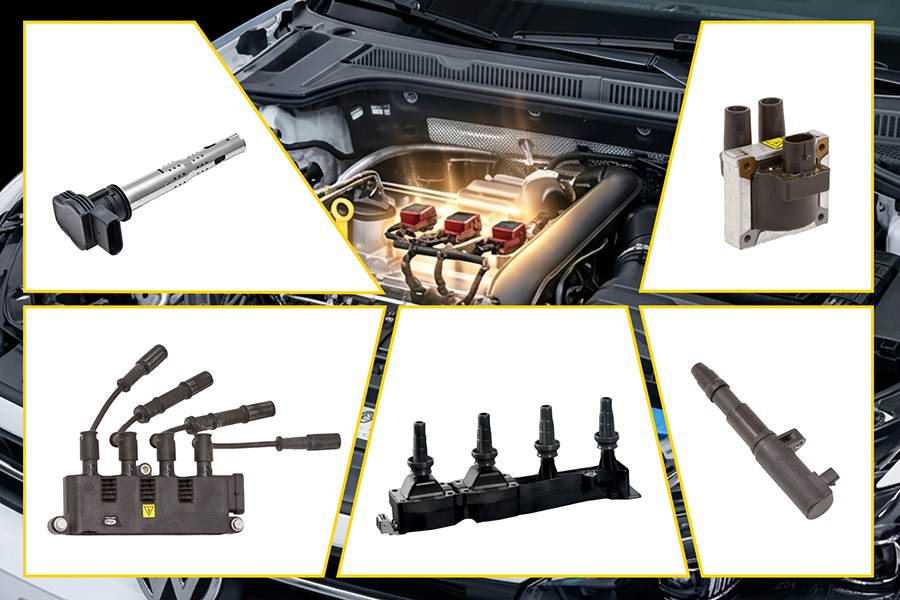
Magneti Marelli Parts & Services further strengthens its electrical and electronic spare parts portfolio with the introduction of over 30 ignition coils, all manufactured to strict OE quality standards and covering applications for the major automotive manufacturers.
This range expansion confirms the brand’s commitment to delivering high‑performance technical solutions with original equipment–level quality, ensuring coverage of approximately 60 million vehicles in the European car parc.
This update enables aftermarket professionals to access components engineered to the same standards required by vehicle manufacturers, ensuring reliability, electronic compatibility, and ignition system performance fully aligned with original specifications.
— Wide application coverage
Magneti Marelli Parts & Services ignition coils are designed for a wide range of applications across vehicles from leading European automotive groups. Coverage includes:
¬ Volkswagen Group (1.0 – 1.2 – 1.4 – 1.5 – 2.0 – 2.4 engines)
¬ Stellantis (1.0 – 1.2 – 1.4 – 1.6 engines)
¬ Renault Group (0.9 – 1.0 – 1.2 – 1.3 – 1.6 engines)
¬ BMW Group and MINI (1.4 – 1.5 – 1.6 – 1.8 – 2.0 – 2.5 – 3.0 – 3.2 engines)
From a technological standpoint, the range includes the most common ignition coil designs used in modern engine management systems:
¬ Pencil coils (coil-on-plug): mounted directly on the spark plug, integrated into the cylinder well, mainly used on four-cylinder engines
¬ Standard coils: traditional design with external mounting on the engine block
¬ Plug Top Coils: direct spark plug mounting with integrated high-temperature silicone boot
¬ Coils Near Plug: near-plug configuration with integrated high-temperature silicone boot
All coils are manufactured in plants supplying leading global automotive OEMs, following certified production processes compliant with IATF 16949 standards.
— OE quality and reliability: what makes the difference versus standard aftermarket
Magneti Marelli Parts & Services ignition coils are distinguished by the use of the same raw materials as those used in original equipment. This aspect, often underestimated, actually represents a substantial difference compared to many aftermarket solutions on the market, even when premium products ones of equivalent quality are concerned, designed to guarantee high standards of performance and reliability.
— Magnetic core and windings
At the core of the ignition coil is a magnetic core made of high‑permeability silicon steel laminations, ensuring efficient electrical energy conversion. The primary and secondary windings are produced using high‑purity electrolytic copper, with a precisely calibrated turns ratio to deliver output voltages between 25 and 45 kV, required to generate a stable spark even under critical conditions such as partially fouled spark plugs or lean air‑fuel mixtures.
Manufacturing precision of the windings directly affects long‑term reliability, ensuring stable electrical behavior throughout the entire service life of the component.
— Insulation and thermal protection
Secondary winding insulation, subjected to voltages exceeding 30,000 volts, is achieved using two‑component epoxy resins applied through a vacuum impregnation process. This technology completely eliminates micro air bubbles which, in lower‑quality products, act as initiation points for internal electrical discharges (dielectric breakdown), leading to premature insulation failure and sudden faults.
The VMQ (Vinyl Methyl Silicone) boot, rated to thermal class H, maintains its elastic properties even after thousands of operating hours at temperatures above 150 °C, a typical condition in the engine compartments of turbocharged or downsized high power‑density engines. Inferior materials tend to harden and crack over time, creating leakage paths to ground and causing intermittent misfires that are difficult to diagnose, as they often do not trigger stable fault codes.
— Connectors and electromagnetic compatibility (EMC)
Electrical connectors feature contacts made from noble materials and application‑specific solutions defined by OEMs, ensuring high corrosion resistance and long‑term electrical contact stability. Protection against moisture ingress or engine washing residues is ensured by optimized mating geometries and sealing systems designed to withstand harsh engine bay conditions.
Oxidized connectors or degraded contacts introduce parasitic resistance that alters coil charging times (dwell time), resulting in reduced spark energy.
These coils also inherit OE‑level electromagnetic compatibility (EMC), certified in accordance with CISPR 25 standards and OEM‑specific requirements. This ensures that the electromagnetic field generated during operation does not interfere with sensors, ECUs, ADAS modules, or driver assistance systems. In modern vehicles—where multiple control units communicate via CAN, LIN, or FlexRay buses—electromagnetic interference can lead to intermittent diagnostic faults or seemingly inexplicable malfunctions.
— Electrical parameters and ECU compatibility
Dimensional and electrical parameters strictly comply with OEM specifications, ensuring:
¬ Correct high‑voltage generation – spark energy between 60 and 150 mJ, sufficient to ionize the air‑fuel mixture even under high combustion chamber pressures typical of turbocharged or stratified‑charge engines
¬ Stable engine performance – primary current curves identical to those mapped in the ECU, with no need for software adaptation
¬ Optimized combustion – consistent spark duration and intensity throughout the entire service life
Integrated electronic functions (IGBT drivers, thermal and overvoltage protection circuits) replicate OE designs exactly, ensuring full compatibility with engine control units and onboard electronics, without adaptation or reprogramming issues.
— Testing and validation processes: no compromises
From design through production, Magneti Marelli Parts & Services ignition coils follow rigorous product validation processes equivalent to those imposed by vehicle manufacturers, exceeding typical aftermarket standards.
Coils undergo thermal cycling tests from –40 °C to +140 °C for over 1,000 hours, simulating extreme cold starts and prolonged high‑load operation. Accelerated endurance testing corresponds to more than 150,000 km of real‑world driving under mixed conditions, verifying the absence of electrical and mechanical performance degradation.
Special focus is placed on dielectric strength testing, applying voltages higher than nominal operating levels to ensure adequate safety margins in the presence of voltage spikes generated by alternators or during jump‑start operations.
All tests are repeated after each production batch, providing an additional guarantee of quality and reliability. The objective is to deliver components capable of maintaining consistent performance over time while withstanding the thermal and mechanical stresses typical of the engine compartment.
— Regulatory compliance and safety
Magneti Marelli Parts & Services ignition coils ensure full compliance with international regulations, supported by chemical traceability through the IMDS (International Material Data System). This enables monitoring of hazardous substance absence in accordance with REACH and RoHS/ELV requirements, while ensuring supply chain transparency, operator safety, and environmental sustainability.
IATF 16949 certification, specific to the automotive industry, guarantees full traceability of every production batch and the implementation of quality control systems designed to prevent systematic defects and ensure consistent supply quality.
— Preventive maintenance: when to replace ignition coils
Even OE‑quality ignition coils are subject to gradual performance degradation over time due to prolonged thermal stress, mechanical vibration, and repeated electrical charge/discharge cycles.
Over the years, these factors can reduce insulation efficiency and spark generation capability, even in the absence of obvious failures.
For this reason, especially at high mileage or during ignition system service operations (spark plug replacement, system overhaul), preventive replacement of ignition coils is recommended to maintain consistent engine performance and prevent intermittent, hard‑to‑diagnose issues.
— Benefits for workshops and industry professionals
OE‑quality ignition coils represent the correct choice for workshops seeking repairs carried out to professional standards. Using Magneti Marelli Parts & Services ignition coils provides tangible operational benefits:
¬ Easy installation and perfect compatibility – no mechanical adaptations or ECU reprogramming required
¬ OE‑equivalent performance – electrical parameters identical to OEM specifications
¬ Higher reliability compared to low‑cost solutions – failure rate below 0.1% within the first 24 months, versus 3–5% for economy aftermarket products
¬ Reduced warranty claims – fewer returns and disputes, delivering direct economic benefits for workshops and distributors
¬ Reliable diagnostics – stable electrical behavior enables accurate scan tool readings and faster fault identification
¬ Higher customer satisfaction – service life comparable to original components, without premature replacements
Using components compliant with OE standards helps avoid issues associated with inferior parts, which can lead to ignition malfunctions, combustion irregularities (rough idle, hesitation under acceleration), increased emissions, or intermittent diagnostic faults that are difficult to resolve.
— An investment in repair quality
Ignition coils are part of a range that covers the vehicle’s main areas with more than 30 product lines: from electrical and electronic components to mechanical parts, from bodywork to products for routine and scheduled maintenance.
This breadth and depth of range is built on the same technical expertise that the brand demonstrates in the OE supply chain, made available to aftermarket professionals as an integrated solution to meet the requirements of any type of service operation.
With this range expansion, Magneti Marelli Parts & Services reinforces its position as a key reference in the automotive aftermarket, offering repair professionals reliable, technologically advanced solutions fully aligned with the requirements of modern vehicles.
Choosing OE‑spec ignition coils represents an investment in repair quality, end‑customer satisfaction, and the professional reputation of workshops and distributors.
-
NEWS2026-10-13At Automechanika Frankfurt 2026 Magneti Marelli Parts & Services showcased spare parts, OE technologies and workshop solutions
-
NEWS2026-09-28Nicolò Bulega is the 2026 Superbike World Champion: Magneti Marelli Checkstar celebrates an extraordinary achievement
-
NEWS2026-09-08Magneti Marelli Parts & Services at Automechanika Frankfurt 2026: an integrated ecosystem of products and services
-
NEWS2026-08-14Magneti Marelli Parts & Services in Prague with French partners
-
NEWS2026-07-23Magneti Marelli Parts & Services expands its Timing Chain Kit range
-
NEWS2026-07-08Magneti Marelli Checkstar: the strength of the network at the Rhodes 2026 incentive event
-
NEWS2026-07-01The World of Magneti Marelli Parts & Services at Automechanika Frankfurt 2026
-
NEWS2026-06-11Magneti Marelli Parts & Services: glamour and adrenaline at the Formula 1 Monaco Grand Prix for Italian partners